Aviation Laser Academy
Operator qualification and Laser Safety Officer certification for Class 4 laser cleaning.
Cold-process surface preparation. No chemical strippers, no abrasive media, no measurable heat rise when operated inside qualified parameters — validated by Textron, and documented for your Part 145 records.
- 23
- Modules
- 66
- Instruction hours
- 8
- Systems in the field
- 0
- Warranty failures
Delivered on site to
Netflix Aviation — Hangar 43, Burbank
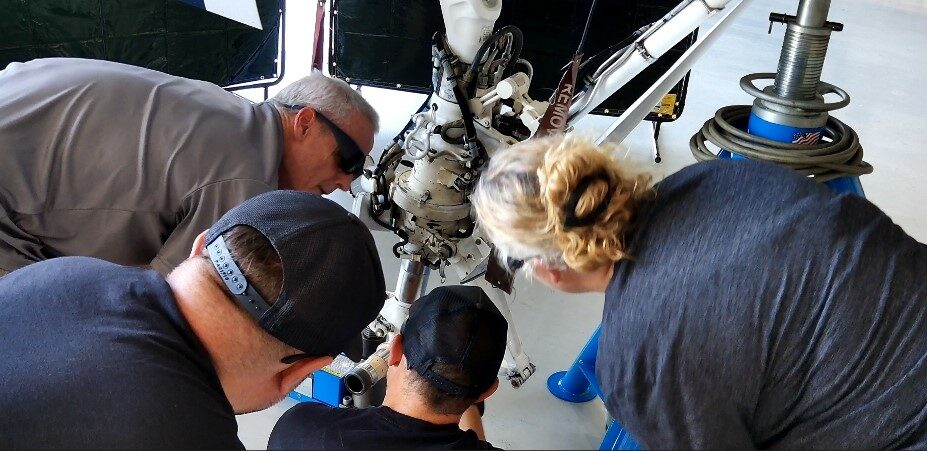
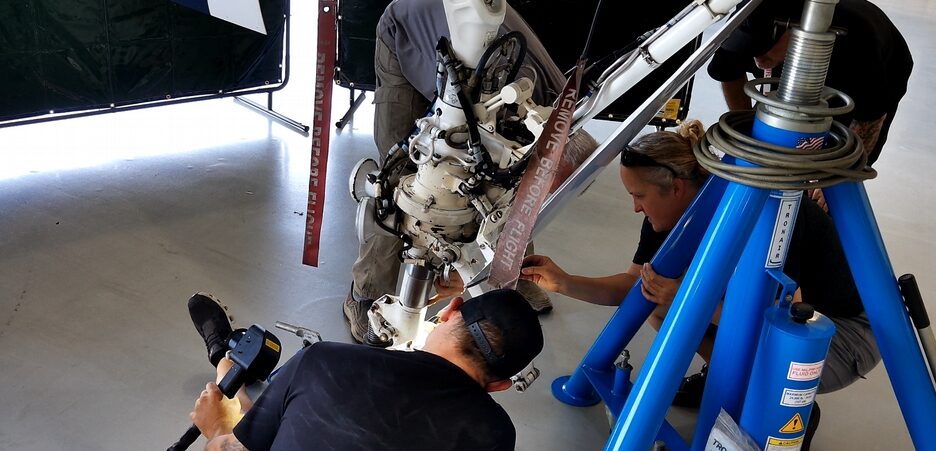
Training delivered on site to a corporate flight department's maintenance team, covering landing gear components including cadmium-plated steel hardware. Netflix Aviation operates an FP-300 in that fleet today.
Landing gear is the hardest case in the curriculum — high-strength steel, cadmium plating that vaporises at a temperature an ablation site reaches trivially, and no margin for getting thermal input wrong.
- 8
- Systems in aviation
- 0
- Warranty failures
The technology is thermally benign. The operator is the variable. This program is what controls the variable.
Which one do I need?
Pick by the role you actually fill. Every package is self-contained — there is nothing to buy first and no order to work out.
You own the laser and run your own shop.
You are the technician — and because ANSI Z136.1 requires every Class 4 operation to designate a Laser Safety Officer, you are legally that too. Most independent operators are here.
→ Complete Aviation Laser Program
You run the laser on aircraft, for an employer or a repair station.
Someone else holds the LSO appointment. You need the aviation work and the safety foundation, not the programme administration.
→ Aviation Laser Technician
You carry the safety responsibility but may never touch a laser.
A director of maintenance or safety manager who holds the appointment while technicians work under it. You need the calculations and the programme, not substrate metallurgy.
→ Laser Safety Officer Certification
You want to teach this programme and certify other people.
Instructors at Part 147 schools and technical colleges, and operators building a training business as a Licensed Affiliate. Beyond the coursework it requires 100 documented hours of removal work and a compliant safety programme at your own operation, both verified first.
→ Master Trainer Certification
You run a Class 4 laser, but not on aircraft.
General shop work, or a helper who works near the machine. The safety foundation on its own.
→ Laser Safety & Fundamentals
Already bought a smaller package? What you paid is credited in full against a larger one, and the modules you have already passed carry over.
What’s in each package
The core programme is 19 modules in three parts. Each package contains whole parts — the safety foundation is built into every one of them. The FP-300 endorsement and the Master Trainer track add their own modules on top, for 26 in all.
Part 1 — Laser Safety Foundation
Modules 1–6
Physics, hazard classification, eyewear, effluent and industrial hygiene, controlled areas, emergency response. Equipment-agnostic.
Part 2 — Aviation Technician
Modules 7–16
Aerospace substrates, clad layer integrity, coating systems, corrosion, composites, the regulatory framework, records, process qualification, hangar operations and business practice.
Part 3 — Laser Safety Officer
Modules 17–19
The role and its authority, hazard evaluation mathematics (MPE, NHZ, optical density), control selection, programme administration, audits, training and medical surveillance.
| Package | Safety Foundation | Aviation Technician | Laser Safety Officer | Hours | Price | Renewal after 24 mo |
|---|---|---|---|---|---|---|
| Laser Safety & FundamentalsGeneral Class 4 | ✓ | — | — | 17 | $895 | $295 |
| Laser Safety Officer CertificationSafety Officer+ Shop Compliance Pack | ✓ | — | ✓ | 28 | $1,295 | $395 |
| Aviation Laser TechnicianAviation Technician | ✓ | ✓ | — | 45 | $2,295 | $595 |
| Complete Aviation Laser ProgramOwner-Operator+ Shop Compliance Pack | ✓ | ✓ | ✓ | 55 | $2,995 | $795 |
| Master Trainer CertificationMaster Trainer+ instructor modules 23–26+ Shop Compliance Pack | ✓ | ✓ | ✓ | 66 | $4,500 | $1,200 |
| FeatherPulse FP-300 EndorsementFP-300 Owners+ FP-300 modules 20–22 | ✓ | — | — | 25 | Included with system | No charge |
Every credential runs 24 months. Renewal covers the modules that have changed, a full re-sit of the final examination and a further 24 months — and the rate is locked at whatever is published the day you enrol.
The Complete Program is $700 more than the Technician package and adds the whole Laser Safety Officer certification. If you own your laser, you need both anyway.
Included, not sold separately
Shop Compliance Pack
The hardest part of running a Class 4 laser in somebody else's hangar is not the laser. It is answering, on the spot, who the Laser Safety Officer is, where the nominal hazard zone ends, what the effluent controls are, and where all of it is written down. These are working documents built for a flight department operating an FP-300, with the customer detail stripped out and placeholders left in its place.
Laser Safety Manualtemplate
Roles, hazard evaluation, engineering and administrative controls, PPE, operating procedures, emergency response, recordkeeping and audit schedule. The document an auditor asks for first.
SMS Implementation Plantemplate
A 30/60/90-day plan to stand up a Safety Management System around laser operations, including the EASA Part 145 supplement path.
SOP to SMS Integration Plantemplate
Maps procedures you already have onto the four pillars of SMS. Enhance rather than replace — existing documentation becomes evidence instead of being discarded.
Corrosion Inspection and Cleaning Checklistform
Field record of corrosion condition before and after work.
Appearance Inspection Reportform
Surface condition record for the file and for the mechanic signing the return to service.
FP-300 Laser Cleaning Guide and Starting Parametersreference
Parameters by coating and corrosion type, scan speed derived from overlap, and the method for verifying any parameter table before use.
Templates, not a compliance product. Your Laser Safety Officer reads every line, adapts it to the facility and signs it. A manual describing a hangar you do not have is worse than no manual.
“Don’t I have to be an A&P mechanic?”
No. And the people who believe you do are leaving work on the table.
You do not need to be an A&P mechanic to perform laser coating removal on aircraft. Under 14 CFR §43.3(d), a non-certificated person may perform maintenance while supervised by a certificated mechanic who personally observes the work to the extent necessary and remains readily available. Under Part 145, a repair station's technicians need not hold individual certificates at all — only supervisory and inspection personnel must (§145.153, §145.155); everyone else must simply be trained and qualified under the station's program. The real gate is not your certificate. It is approved data for the process, and a training record that survives an audit.
What this credential is
The Aviation Laser Academy issues an industry operator qualification. It is not an FAA certificate and confers no FAA authority. What it does provide is the documented, auditable training record a certificated mechanic or Part 145 repair station needs in order to qualify you on a laser coating removal process under their approved data and training program (14 CFR §145.151, §145.163).
What this program covers that others don’t
Heat is the damage mechanism everybody names. It is not the one that most often destroys an airframe.
Clad layer penetration
Not thermalAlclad 2024 and 7075 carry a thin commercially-pure aluminium cladding that provides galvanic corrosion protection for the copper-bearing core. Ablating through it is a material-removal failure that occurs at parameters nowhere near a concerning bulk temperature, leaves no visible indication, and cannot be undone.
Cumulative thermal input
ThermalSingle pulses are benign. Pass count, dwell, overlap and repetition rate accumulate. Thin skins and honeycomb face sheets reach limits far sooner than an operator's intuition suggests.
Surface roughening outside specification
Not thermalRa outside the specified band compromises adhesion of the replacement coating system and can act as a fatigue initiation site on a fatigue-critical member.
Composite matrix degradation
ThermalResin degrades well below the temperature at which anything visible happens. Fibre exposure or matrix burn-back on a structural laminate is a repair, not a blemish.
Selective-removal failure
Not thermalStopping short leaves primer that compromises the new coating system. Going long takes cladding or base metal. The endpoint is a judgement the operator makes hundreds of times a shift.
Bondline and sealant contamination
Not thermalAblation products redeposit. A contaminated faying surface or bondline fails later, somewhere else, for reasons nobody connects back to the paint shop.
The exposure nobody is controlling
Ablating legacy aviation coatings aerosolises hexavalent chromium from chromate primers and cadmium from plated fasteners. OSHA 29 CFR §1910.1026 sets a permissible exposure limit of 5 µg/m³ for Cr(VI) with an action level of 2.5 µg/m³, and §1910.1027 governs cadmium. Extraction, filtration, respiratory protection and exposure assessment are not optional good practice — they are the enforceable law that most laser cleaning operations are currently violating without knowing it.
Taught in the field, not just written down
This curriculum is the instruction already being delivered to operators running these systems commercially.
Netflix Aviation
Hangar 43, Burbank, California · 2025Training a corporate flight department's MRO team on landing gear
Netflix Aviation operates an FP-300 in its corporate aviation fleet maintenance operation. Training was delivered on site at Hangar 43, covering laser cleaning of landing gear components — including cadmium-plated steel hardware — with emphasis on monitoring substrate temperature and cumulative thermal input in real time using non-contact IR measurement.
Landing gear is the hardest case in the curriculum. The components are high-strength steel, frequently cadmium plated, and cadmium vaporises at a temperature an ablation site reaches trivially — which makes it both the sharpest thermal-control exercise and the clearest demonstration of why 29 CFR 1910.1027 applies to this work.
Curriculum demonstrated
- •Module 4 — cadmium effluent and exposure control
- •Module 7 — high-strength steels and cadmium plating
- •Module 14 — substrate temperature verification during work
- •Module 24 — on-site demonstration and supervised operation
Written from the field, not from a textbook
Eight FeatherPulse systems are deployed and working in aviation MRO today — to our knowledge the largest working aviation fleet of any laser cleaning company in the United States. Zero recalls. Zero warranty failures. The curriculum is built from what those eight machines and their operators have actually run into.
Important
Aviation Laser Academy is a private training provider. This credential is an industry operator qualification and is not issued, approved, recognised or endorsed by the Federal Aviation Administration. It confers no authority to approve an aircraft for return to service. Authority to perform maintenance derives from 14 CFR Part 43 and Part 65, and the acceptability of any process for a given aircraft derives from approved or acceptable data for that aircraft. Holders remain responsible for operating within their own authority, their employer's procedures, and applicable federal, state and local law.