
Non-Destructive Cleaning
Contaminants like paint, primer, and corrosion absorb the laser's energy and vaporize. Bare aluminum reflects it. That selective absorption is why the FP-300 removes coatings without damaging the metal underneath.
Unlike sanding or blasting, the laser never touches the surface. There's no risk of scratching, thinning, or distorting the aluminum. And unlike chemical strippers, there are no toxic solvents, no hazardous waste streams, and no environmental compliance headaches.
Verified by Textron Aviation
Independent Cross-Sectional Analysis
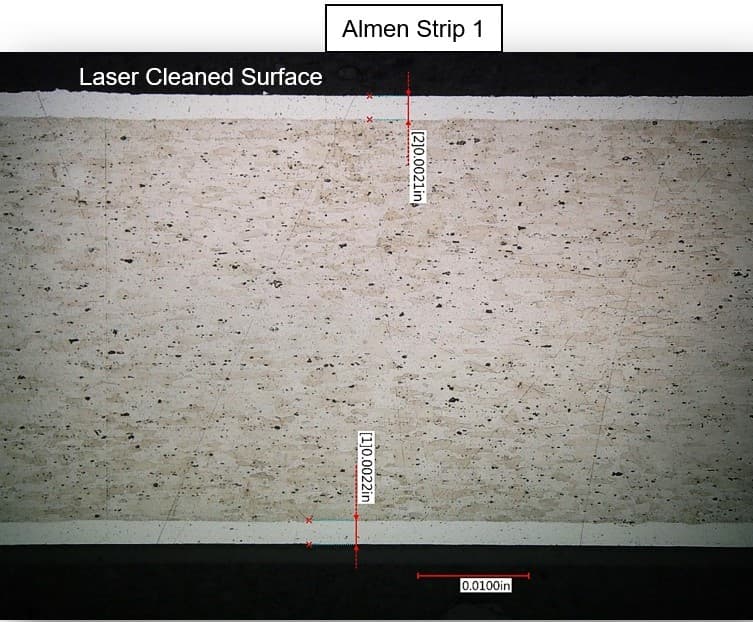
“We did not observe any damage of the alclad layer on the thin aluminum that had been ablated with the laser.”
Textron Aviation performed cross-sectional microscopy on Almen strips cleaned with the FP-300. The alclad layer was fully intact, with zero substrate thickness reduction and no heat-affected zones at the ablation boundary.
What the Research Shows
Peer-reviewed aerospace studies confirm that laser cleaning maintains or improves material properties when applied with optimized parameters.
Corrosion Resistance
Equal or Better
Studies show that aluminum cleaned with lasers has equal or better corrosion resistance compared to mechanically abraded surfaces. The process forms a thin, uniform oxide layer that protects the surface until repainting.
Mechanical Strength
No Reduction
Fretting wear around rivet holes — a critical weak point — was tested. Results showed no reduction in fatigue or wear resistance compared to traditional cleaning methods.
Surface Hardness
+10% Increase
On 2024-T351 aluminum (common in aircraft skins), laser paint removal increased surface hardness by approximately 10%. Microscopy confirmed grain structure refinement.
Tensile Strength
+8% Increase
Laser-cleaned 2024-T351 aluminum showed an approximately 8% increase in tensile strength. The process refines the grain structure of the alloy, making the material tougher against fatigue.
Post-Cleaning Quality Targets
Every FP-300 cleaning job should meet these measurable standards before the panel is released for repainting or inspection.
See the results for yourself
Schedule a demo or request before-and-after evidence from our completed projects.