

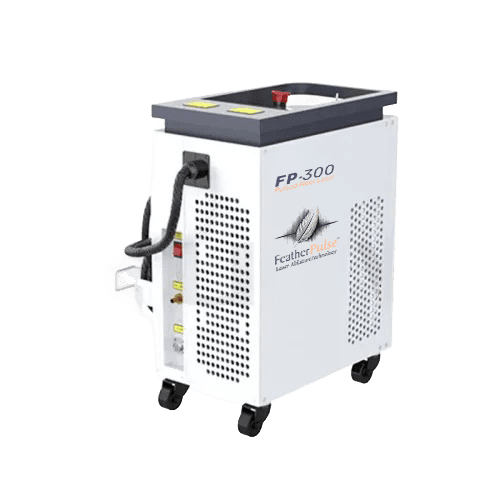
300W Pulsed Fiber Laser
The FP-300 FeatherPulse uses a 300-watt pulsed fiber laser source operating at 1064nm. Energy is delivered in short, controlled bursts — not a continuous beam — giving you precise control over how the laser interacts with every surface.
Adjustable pulse duration from 20 to 200 nanoseconds, repetition rates up to 500 kHz, and four scan patterns let you dial in the exact parameters for any coating, corrosion, or substrate.
Why Pulsed Matters
Pulsed fiber lasers emit energy in short, controlled bursts rather than a continuous wave. This is the fundamental reason the FP-300 can remove paint without damaging aluminum.
Pulsed, Not Continuous Wave
The FP-300 delivers energy in short, controlled bursts (nanoseconds to microseconds) rather than a continuous beam. This prevents heat from spreading into the underlying metal — the key to non-destructive cleaning.
Three-Parameter Control
Power, pulse duration, and frequency work together. Adjusting any one changes how the laser interacts with the surface — from gentle oxide removal at 50W/20ns to aggressive paint stripping at 270W/175ns.
1064nm Wavelength
The ytterbium-doped fiber produces light at 1064nm — a wavelength strongly absorbed by paint, primer, corrosion, and organic contaminants, but reflected by bare aluminum. This selective absorption is why the substrate stays undamaged.
Core Specifications
Power Range by Application
The FP-300's full 300W range covers everything from delicate aluminum cleaning to aggressive heavy corrosion removal.
50–120W
Delicate Materials
Aluminum, copper, thin metals. Short pulses (10–50 ns) at high frequency (150–500 kHz) minimize heat transfer to prevent warping.
100–200W
Coatings & Rust
Standard paint, primer, and moderate corrosion. Medium pulses (50–200 ns) at 50–200 kHz provide balanced removal and heat control.
200–300W
Heavy Corrosion & Thick Coatings
Epoxy systems, thick primer, heavy pitting. Longer pulses with lower frequency for maximum material removal without substrate degradation.
Validated Energy Thresholds
Based on MRO testing and FAA compliance verification. These are the energy densities (fluence) at which specific materials respond.
The FP-300 operates well below the aluminum damage threshold at recommended settings. Source: Aviation Laser Services MRO testing, FAA AC 43.13-1B compliance.
See the FP-300 in person
Get a quote, schedule a demo, or ask a technical question. We ship nationwide from Cove, Arkansas.